We The North market: Canada’s bilingual darknet market
Updated
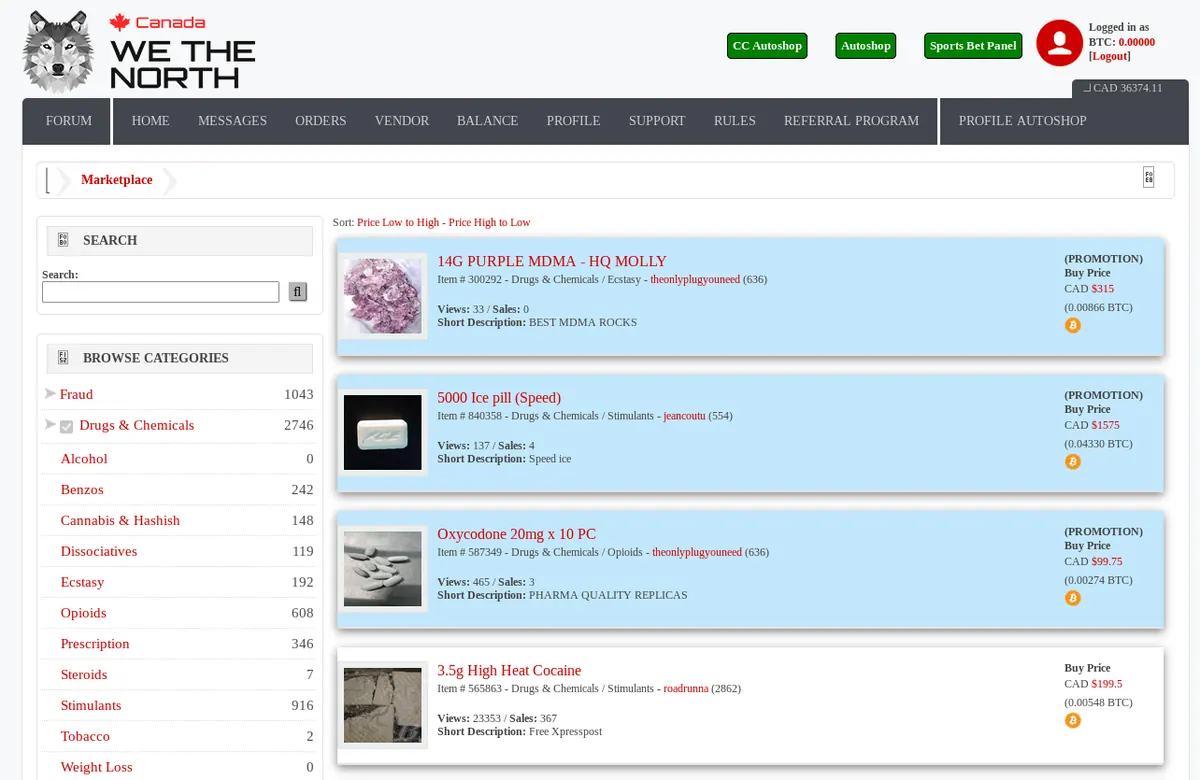
We The North, usually written WeTheNorth or WTN, is a darknet market for Canada only. It launched in July 2021, takes its name from the Toronto Raptors slogan, runs in English and French, and shows prices in Canadian dollars while taking payment in Bitcoin and Monero. It is mid-sized, still trading in 2026, and the only serious regional market Canada has. Its pitch is domestic shipping and “reduced customs risk”. The first is real; the second is a sales line, because domestic parcels still go through the post.
Where WeTheNorth came from
WeTheNorth first showed up in July 2021 in advertisements on Reddit and other open forums. The Canadian HeadQuarters, the previous Canada-focused market, had recently shut down, and WTN was set up to take its place, with the same audience and a similar pitch. It has been running ever since, which makes it the oldest market among the six we cover.
Its mission statement, posted on the market at launch, says exactly who it was built for:
to provide a safe environment so that Canadians are able to purchase safely, scam-free and away from the street violence, drugs and other items that are more potent, cleaner and safer to use.
Read it as marketing. “Scam-free” is a promise no escrow system can keep, and “cleaner and safer” is a vendor slogan, not a lab result. The mission names its audience: Canadians.
What a regional market does differently
A global market like Torzon lists anything a vendor anywhere will ship anywhere. WeTheNorth narrows that to one country, and the narrowing shows up in every part of the product.
| WeTheNorth | Global generalist | |
|---|---|---|
| Who it serves | Canadian buyers and vendors | Anyone, anywhere the vendors ship |
| Language | English and French, with support in both | English |
| Prices | Canadian dollars | U.S. dollars |
| Shipping | Domestic, by design | International, customs on most orders |
| Fraud section | Canadian-format IDs and local fraud | Mostly U.S. and EU material |
| Catalogue | A few thousand listings | Tens of thousands |
For buyers in Quebec it is the main draw, since the large global markets run in English only. Canadian-dollar prices remove the mental conversion and the exchange-rate surprise. Neither changes how the money moves: payment is still in Bitcoin or Monero, and the price in CAD is just a display.
What WeTheNorth sells
Drugs are the bulk of the market, as they were from the start: in its first months the top sellers were cannabis, cocaine, and party drugs. Behind them sit the sections that make WTN interesting to security teams as well as buyers: stolen cards, account logins, counterfeit Canadian documents, fraud guides, and a smaller software and malware aisle. Canadian IDs get their own category.
The rule list has stayed short and consistent since launch: no weapons, nothing related to terrorism, and no phone numbers or other contact details in listings, which stops vendors from pulling buyers off the market where the escrow cannot protect anyone. Vendors pay a non-refundable fee to open a shop, must use two-factor login, and are banned for fake reviews. Like most markets, WTN also bans explosives and child abuse material.
The listing counter has shown anything between about 5,000 and 9,000 in 2026, depending on when you look and what it counts. That puts WeTheNorth at a fraction of Torzon’s size and roughly level with the mid-sized generalists. For a market that only serves one country of 40 million people, it is large.
Domestic shipping is not a safety feature
WeTheNorth sells itself on keeping parcels inside Canada: no border, so no customs inspection, faster delivery, and, in its own words, “reduced customs risk”. The first half is accurate. International mail entering Canada passes through border inspection; a parcel posted in Winnipeg to Halifax does not. That is a genuine difference from ordering through a global market.
It removes the border inspection; every other risk stays. A buyer has no way to confirm that a vendor who promises domestic shipping is actually in Canada, and a vendor who imports in bulk and reships domestically has simply moved the border risk to themselves. Domestic mail is still mail, and what is illegal to order from abroad is just as illegal to order from Ontario. “Safer” in the market’s pitch means fewer points where a parcel can be stopped, not a safer act.
Fake We The North market links lean on Canadian branding
Clones of WeTheNorth dress up as the market more convincingly than most, because national branding is easy to copy: a maple leaf, a French FAQ, prices in CAD. Clearnet pages calling themselves the “Official Canadian Darknet Marketplace” print an established year, a coin list, and a 99.9 percent uptime figure with no source, and end on an address list. A market that lives on Tor gains nothing from a clearnet storefront that hands out its addresses to search engines; the people who gain are the ones swapping those addresses.
The defence is the same as for any market: a mirror list signed with the market’s PGP key, checked against a key you saved earlier. How phishing copies work in general is on the markets overview.
Who WeTheNorth suits
WeTheNorth makes sense only inside Canada, and inside Canada it has no real competitor. For French-speaking buyers it is the only market that talks to them in their language. It does not serve buyers outside Canada.
Its weak side is custody. The escrow is held by the market and there is no multisig, so WTN carries the same exit risk as Torzon or Abacus did, on a smaller pile. Five years without an exit is a long record, but the escrow is still under one team’s control. How market-held escrow fails, and what multisig would change, is on the darknet economy page.
What the record on We The North rests on
No agency record covers We The North, so this page rests on public write-ups and the service’s own description: a July 2021 launch, Canada only, English and French. Statements about its size and about what its customs claims are worth are our reading of that material, not measurements. We have not used the service. Our editorial standards explain how we label claims of this kind.