How darknet markets are shut down: infrastructure, databases, and joint operations
Updated
When people ask how darknet markets are shut down, they usually mean police takedowns, not an exit scam or a voluntary retirement. A law-enforcement shutdown is rarely one dramatic raid on a single laptop. Agency announcements describe a stack of steps: locate and seize the servers, copy the database, trace cryptocurrency flows, sometimes run the site covertly to collect evidence, then coordinate arrests across countries months or years later. This page explains those mechanisms from Justice Department, Europol, and German federal police (BKA) releases. The order of events, market by market, lives on darknet market history; here the question is what investigators do, not when each site closed. For how money moves through a market before that moment, see darknet economy; for how coins are traced after payments leave the site, see darknet crypto.
Infrastructure seizure comes first
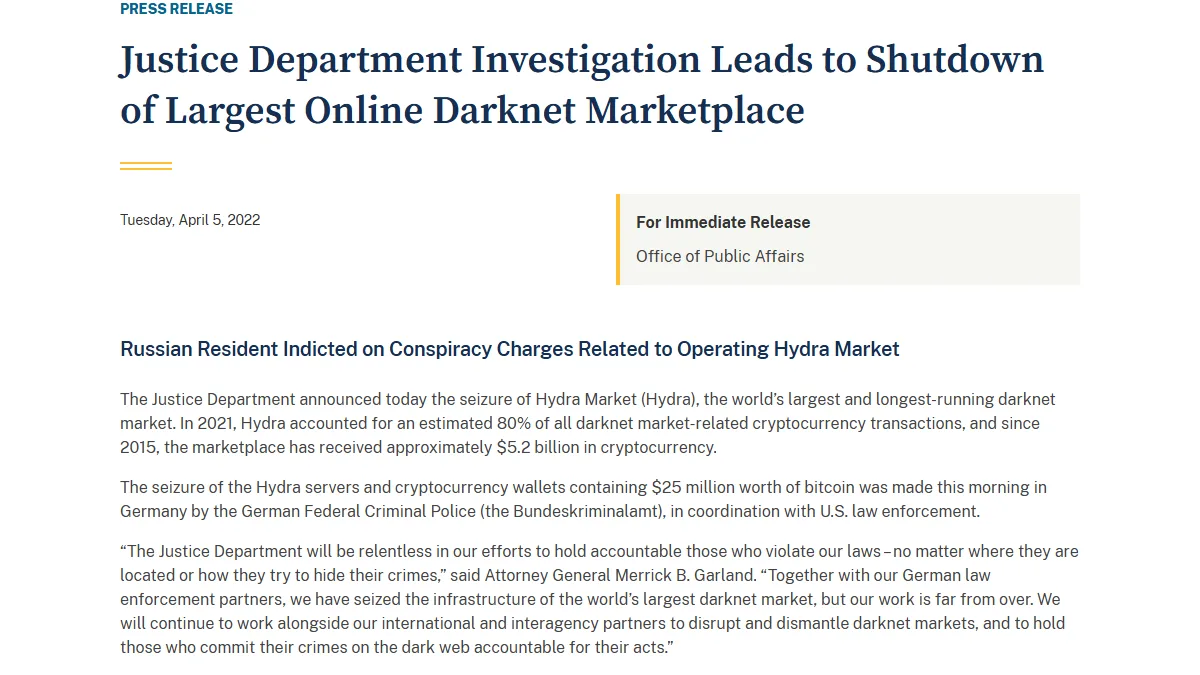
On the Tor network, a market is software on servers plus keys that keep the hidden service reachable. Shutting the market down means those servers stop answering, and users see a law-enforcement banner instead of listings. The Justice Department’s Hydra announcement on 5 April 2022 says German federal police seized Hydra’s servers and cryptocurrency wallets in Germany, holding about $25 million in bitcoin. The same release describes Hydra as the world’s largest and longest-running darknet market, with an estimated 80% of darknet market-related cryptocurrency transactions in 2021—figures only possible because investigators had already mapped its financial footprint.
Archetyp in June 2025 followed the same pattern at larger scale. The BKA press release of 16 June 2025 states that Dutch police seized and shut down the server infrastructure in a Netherlands data centre that powered Archetyp Market, while a 30-year-old German national alleged to be the administrator was arrested in Barcelona on 11 June 2025. Europol’s Archetyp notice lists Germany, the Netherlands, Romania, Spain, and Sweden among the countries involved and puts platform turnover at at least EUR 250 million. Payment on Archetyp was in Monero only, according to the BKA; seizing infrastructure does not depend on which coin the market used.
Infrastructure work is not limited to drug markets. The same coordination model appears against stolen-data bazaars and leak sites named in other agency actions; our pages on stolen data shops and ransomware leak sites cover those categories separately. The mechanism—find the hosting, preserve the disks—is the same even when the goods are credentials rather than parcels.
How investigators find the servers
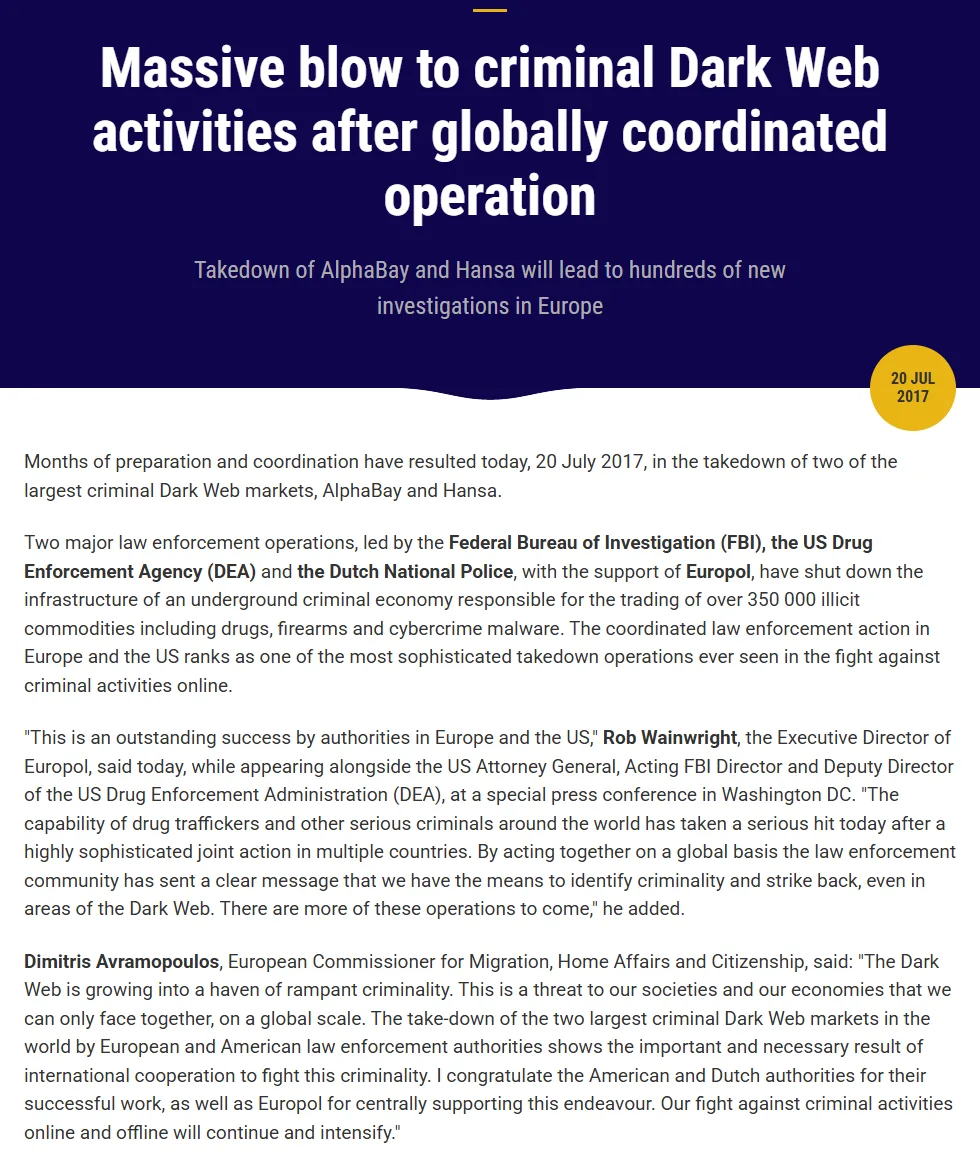
Agency pages rarely publish a full technical chain, but they do describe the outcome: a physical jurisdiction where police can act. The 2017 AlphaBay and Hansa takedowns are the clearest joint illustration. Europol’s 20 July 2017 release says enquiries located Hansa’s infrastructure in the Netherlands, Dutch police arrested two administrators in Germany, and servers were seized in the Netherlands, Germany, and Lithuania. That is server tracing reduced to a sentence: map where the site actually runs, then use national law to enter those premises.
Operational mistakes also surface in case files cited on other pages. The BKA’s 2019 account of Wall Street Market, referenced on market history, describes administrators exposing a real IP address after a VPN failure—an example of how hosting and operational security errors become a server location. We do not repeat that chronology here; the point for enforcement is that takedowns often begin outside Tor, at the host, the payment rail, or the administrator’s physical address once identified.
Blockchain analytics and financial leads
Many markets still settle in Bitcoin or route funds through services named in court papers. The DEA’s AlphaBay release of 20 July 2017 credits cooperation that froze and preserved millions of dollars’ worth of cryptocurrency subject to forfeiture, and names IRS Criminal Investigation among the agencies that “used its unique financial and cyber expertise” to tie wallets to the operation. The Hydra indictment narrative in the April 2022 Justice Department release describes Hydra’s in-house mixing and commission structure in detail—evidence that the financial design of the market was part of the charging story, not an afterthought.
Tracing does not replace server seizure; the two reinforce each other. Treasury sanctions, exchange subpoenas, and blockchain analytics firms appear in parallel announcements when a market’s administrators or cash-out providers are identified. The limits of tracing—especially where a market is Monero-only—are on darknet crypto; Archetyp’s takedown shows that police still proceeded through infrastructure and identity work when the ledger was hidden.
Covert control and undercover administration
The most unusual mechanism in public records is temporary police control of a live market. Europol’s 2017 Hansa account states Dutch police took over Hansa on 20 June 2017 under Dutch judicial authorisation and monitored criminal activity on the platform until it was shut down on 20 July 2017—the same day AlphaBay was seized. The strategy section of that release explains the logic: shut down the largest site (AlphaBay) while covertly running the third-largest (Hansa), so users who migrated after AlphaBay’s fall flowed into a marketplace police already controlled. Europol says about 10,000 foreign buyer delivery addresses from Hansa were passed to Europol during that period.
The DEA’s AlphaBay announcement explicitly pairs the AlphaBay seizure with Dutch action against Hansa, describing both as hidden-service markets whose administrators tried to mask identities with Tor and cryptocurrency. These are not generic “undercover buys”; they are full-platform control authorised under national law, described at a high level in press releases rather than in technical manuals. We do not describe tools or techniques beyond what those documents state.
Seized databases and later arrest waves
Server seizure is the visible moment; database exploitation is often the longer work. Europol’s Operation SpecTor release on 2 May 2023 says German authorities had seized Monopoly Market’s criminal infrastructure in December 2021, and Europol built “intelligence packages” from that evidence—cross-matched data that became the basis for hundreds of national investigations. SpecTor’s results: 288 arrests in nine countries, more than EUR 50.8 million in cash and virtual currencies seized, 850 kg of drugs, and 117 firearms. The marketplace operator was located in Austria in November 2022 and extradited to the United States in June 2023, according to the same release.
Operation RapTor in May 2025 scaled the same model. The Justice Department announcement on 22 May 2025 reports 270 arrests across ten countries and more than $200 million in currency and digital assets seized, built on prior takedowns of infrastructure tied to Nemesis, Tor2Door, Bohemia, and Kingdom Market. RapTor is therefore not a single new hidden service URL; it is a coordinated result of cases that used seized market data and follow-the-money work, announced together under one operation name. Recent case examples in that release—including the Incognito Market guilty plea—show how long the pipeline can run after a site stops trading.
For readers comparing operations, the important distinction is market seizure versus arrest campaign. Hydra’s servers were taken in April 2022; SpecTor’s hundreds of arrests in 2023 largely reflect Monopoly’s 2021 server case; RapTor’s 2025 headline counts vendors and buyers on markets already dismantled. None of those press releases promise that every user of a seized site will be charged; they do state that buyer lists create prosecution risk, as SpecTor explicitly warns.
Joint operations named in agency records
| Operation / market | Date (agency) | What agencies describe | Primary record |
|---|---|---|---|
| AlphaBay / Hansa | 20 July 2017 | Server seizures; covert Hansa control from 20 June 2017; cryptocurrency forfeiture; international coordination | Europol; DEA |
| Hydra | 5 April 2022 | German server and wallet seizure (~$25 million bitcoin); U.S. charges against alleged infrastructure operator | Justice Department |
| Operation SpecTor (Monopoly evidence) | 2 May 2023 | Intelligence packages from Monopoly infrastructure seized December 2021; 288 arrests; operator extradition | Europol |
| Operation RapTor | 22 May 2025 | 270 arrests; seizure totals; leads from Nemesis, Tor2Door, Bohemia, Kingdom infrastructure | Justice Department |
| Archetyp (Deep Sentinel) | 16 June 2025 | Netherlands server takedown; Barcelona administrator arrest 11 June; parallel vendor actions | BKA; Europol |
Coordinating bodies recur: Europol’s European Cybercrime Centre, FBI-led JCODE in U.S. opioid and darknet cases, and national units such as the BKA and the UK National Crime Agency, each listed in the SpecTor and RapTor releases. Breaking news summaries belong on darknet news; the live market landscape is on darknet markets.
Questions people ask about darknet market takedowns
How do law enforcement agencies find darknet market servers?
Public case summaries point to international cooperation to locate infrastructure in a real country, then seize equipment in data centres—as with Hansa’s servers in the Netherlands described by Europol in 2017, Hydra’s servers in Germany in 2022, and Archetyp’s Dutch hosting in 2025. Releases usually state the outcome rather than every investigative step.
What happens to vendor and buyer data when police seize a market?
Agencies treat the database as evidence. Europol’s SpecTor release says vendors arrested on Monopoly-related work were active on other markets too, and that extensive buyer lists put thousands of customers at risk of prosecution. That is the practical consequence of a full server image: usernames, orders, and messages become searchable in national investigations.
Can people be arrested years after a market is shut down?
Yes, when cases are built from stored data and financial follow-up. SpecTor in 2023 rested on Monopoly infrastructure seized in 2021; RapTor in 2025 cited markets taken down earlier. Individual charges still require national legal process; an indictment is an allegation, not a conviction.
What was Operation SpecTor?
Europol’s codename for coordinated arrests and seizures announced on 2 May 2023, based in part on evidence from Monopoly Market’s infrastructure, which German authorities had seized in December 2021. It is distinct from shutting down a single new URL on that day—it was mainly an arrest and asset-recovery wave.
Do police ever secretly run a darknet market before shutting it down?
Europol documented that model for Hansa in 2017: Dutch police ran the market covertly for about a month before the public takedown alongside AlphaBay. That is the clearest official description of full-site covert administration; it is not presented as a routine step in every case.
How does cryptocurrency tracing help shut down darknet markets?
Agencies link market wallets, commissions, and cash-out services to identifiable defendants and forfeiture targets. AlphaBay and Hydra announcements both describe large-scale cryptocurrency flows as part of the enforcement story, with IRS-CI and other financial units named on AlphaBay.
How we know what we say about darknet enforcement
Every operation named on this page links to the Justice Department, Europol, DEA, or BKA document that states the figure or date. We have not used any darknet market. Where a mechanism is illustrated on market history with a dated closure, this page keeps only the enforcement method. Exit scams and voluntary retirements are not police shutdowns and are out of scope here. Our rules for sources and labels are in editorial standards.