Torzon Market: how it inherited Abacus’s users, and what its escrow risks
Updated
Torzon Market is a generalist market that has run on Tor since September 2022, and one event explains why it is searched for: Archetyp was seized in June 2025 and Abacus exit-scammed in July, and a large share of their vendors and buyers moved to Torzon. This page follows that handoff, explains its market-held escrow (Bitcoin and Monero, no multisig), and shows why the Torzon name is the one clone sites push hardest. For how it compares with the other markets, see darknet markets in 2026.
How Torzon became the default after Abacus
For its first two and a half years Torzon was a mid-sized market in the shadow of Abacus and Archetyp. Then both disappeared inside a month. Archetyp was seized by German police in June 2025, with its alleged founder arrested in Barcelona on 11 June, and the indictment filed in August 2026 describes a market with more than 3,000 vendors and 600,000 customer accounts. Abacus, the largest Western market, went dark in early July 2025 with withdrawals frozen and no police banner, the classic shape of an exit scam.
Those vendors and buyers had to go somewhere, and Torzon was the obvious choice. It already took both Bitcoin and Monero, so neither group had to change coins. It had been running long enough to have a record. It was large enough that vendors could expect buyers to follow them. Within weeks of the Abacus exit, established Abacus vendors had reopened on Torzon under their old PGP keys, and by the end of 2025 it was the market most English-speaking buyers meant when they said “the big one”.
It is what happens every time a dominant market closes: the traffic goes to the largest survivor that looks familiar. Dream Market got the same wave after AlphaBay in 2017. The darknet market history has the longer chronology.
What Torzon’s size means for the people using it
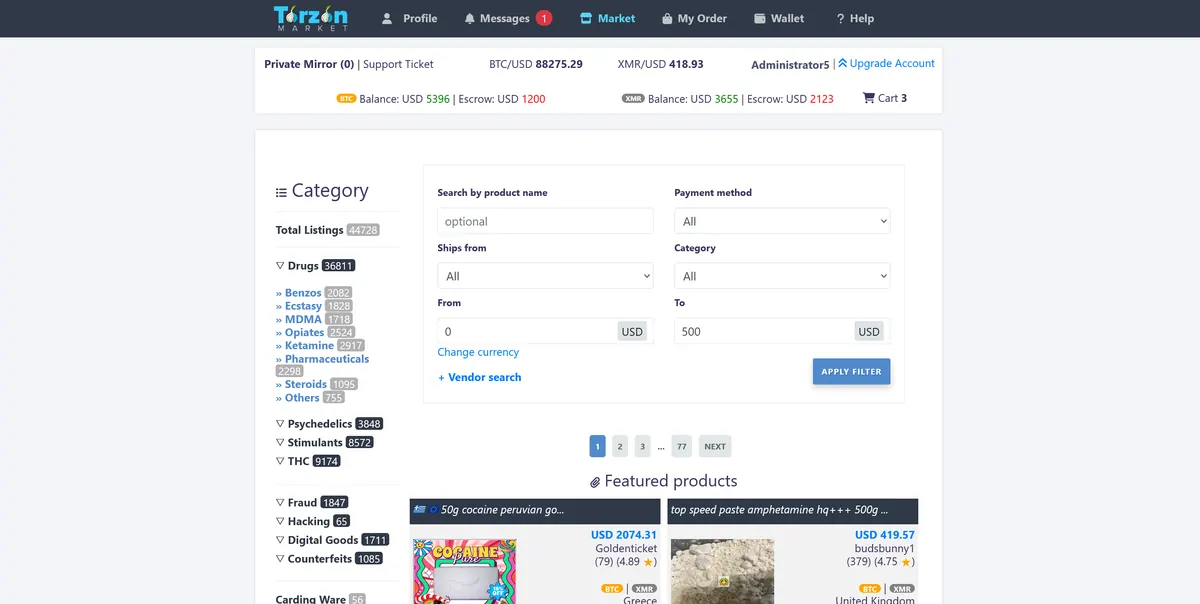
Torzon’s catalogue runs well into five figures, though the exact number depends on the day and on how you count. The front-page total includes duplicates and dead listings, so the working catalogue is smaller than the counter. Either way, it is several times bigger than any other English-language generalist still trading.
Size helps buyers in obvious ways. More vendors means more choice, more competition on price, and more reviews per vendor, which makes a bad vendor easier to spot. Established vendors from Abacus and Archetyp kept their PGP keys and names when they moved, so their reputations came with them.
Size also concentrates every risk a market carries. The escrow balance on the biggest market is the biggest prize for an exit scam. The biggest market is the first target for police: Archetyp was the largest drug market in the world when it was seized. And the biggest market is the one competitors and extortionists flood with DDoS, which is why Torzon’s public mirrors go down regularly.
Torzon’s escrow is the ordinary kind
Torzon uses traditional market-held escrow. A buyer pays into the market’s wallet, the market holds the coins until the buyer confirms delivery, and then releases them to the vendor, minus its commission. There is no 2-of-3 multisig. Established vendors can ask buyers to finalize early, which releases the payment before the goods arrive.
In practice this means Torzon works like Abacus did. If the operators stay honest, the system protects buyers from bad vendors through disputes. If the operators leave, every coin sitting in escrow and every balance in a user wallet leaves with them. Most markets have always worked this way, and it is exactly what drained Abacus users in 2025. What pooled escrow is, what multisig would change, and what finalize-early really transfers is on the darknet economy page.
Torzon link sites, mirrors, and phishing copies
Torzon is the name clone sites push hardest, for the same reason it draws the most DDoS: it is the biggest target. Clearnet pages calling themselves the official Torzon link sit at the top of every search. They come with author names, “last updated” dates, and listing statistics that do not match the market’s own, and some describe the escrow as multisig, which it is not.
The dangerous moment is right after an attack. When the public mirrors go down, people who only know Torzon through a bookmark start searching for a new address, and the first result is often a phishing proxy: a real onion that relays the genuine market page by page while recording logins and swapping deposit addresses. Everything looks right. The deposit never arrives.
The defence is the one every large market relies on. Torzon publishes its current mirrors in a message signed with its PGP key, on its own onion and on Dread. Someone who saved the market’s public key on an earlier visit can verify any new address in a minute. Someone who did not has no way to tell a real mirror from a vanity address that matches the first several characters, which is exactly what the clone sites count on. How onion addresses and signatures work is covered on useful onion links.
Where Torzon falls short
Torzon is the default choice, and on custody it is among the weaker ones. The custody model is the oldest and weakest one: centralized escrow, no multisig, and finalize-early on the table for big vendors. A market whose whole growth came from another market’s exit has inherited that market’s exit risk along with its users.
Torzon’s pull is size and familiarity, which is what most people choose on; its weakness is custody: market-held escrow, no multisig, and finalize-early for large vendors. How the other markets handle custody, and which of them have exited, is compared side by side on darknet markets in 2026.
How we know what we say about Torzon
The Archetyp details come from the BKA press release on the August 2026 indictment, linked above. Everything about Torzon itself, including its launch year, coins, escrow design, and the move of users after Abacus, comes from public write-ups and the service’s own descriptions, and we have not been on it. The catalogue size is a counter the service displays, not a measurement. Read more in our editorial standards.