Darknet forums in 2026: Dread, the Russian-language boards, and Telegram
Updated
The main English-language darknet forum is Dread, a Reddit-style board on Tor launched in 2018, where people discuss markets, warn about scams, and argue about whether a shutdown is real. It is not the only kind of forum. Russian-language boards such as XSS and Exploit.in are where hackers sell network access and malware, and leak forums such as BreachForums and its successors trade stolen databases. Telegram, which is not on the dark web at all, now carries much of the fast traffic: vendor channels, leak dumps, and card shops. These are three different kinds of place with different users, and ranking them in a single list mixes them up.
What the Dread forum is and where it came from
Dread is an English-language discussion forum, available only as an onion service, built to look and work like Reddit. It was created in early 2018 by an administrator known as HugBunter, who runs it with a second administrator, Paris. Registration is optional; anyone can read most of it.
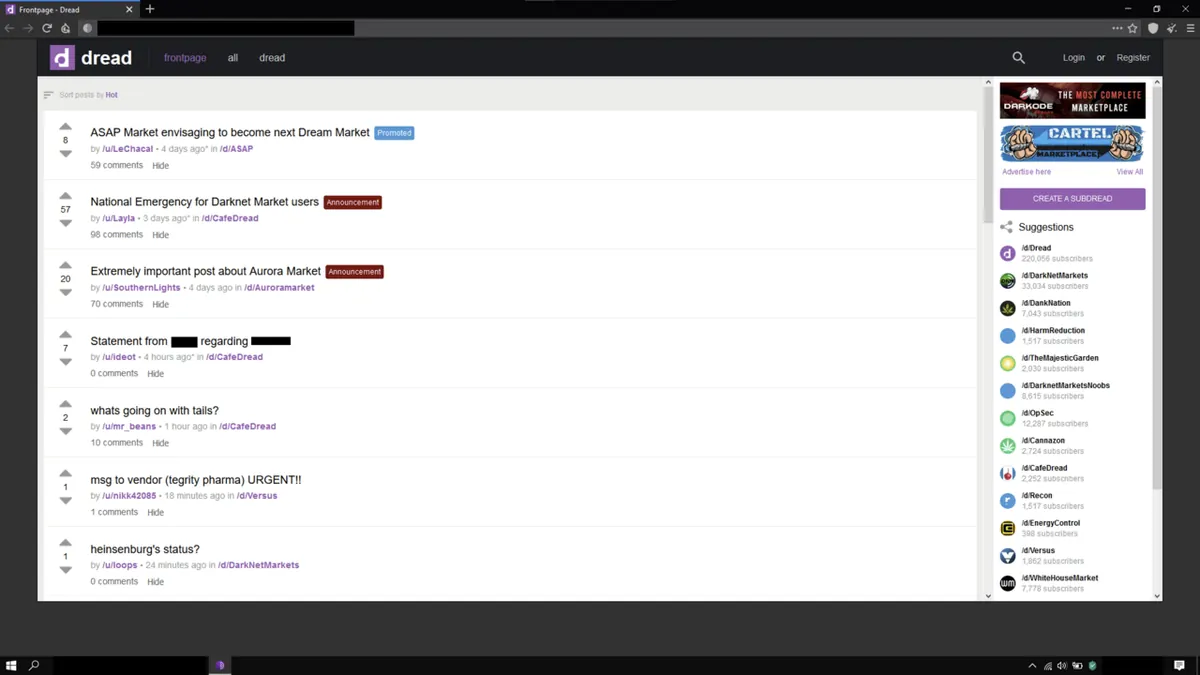
Its timing was not an accident. In March 2018 Reddit banned the subreddits where darknet market users had gathered for years, and the previous summer police had taken down AlphaBay and Hansa, the two biggest markets of the time. Users needed a new place to talk, and Dread offered the same format they knew, on Tor. It had more than 12,000 registered users within three months. The last public user count, from 2019, was about 121,000.
Dread became the place where market news breaks. Dream Market announced its closure there in March 2019. In May 2019 a Wall Street Market moderator, angry about the market’s exit scam, posted the market’s real server address there. Markets keep their own boards on Dread for announcements and support, and users report scams and fake mirrors there first. Prosecutors read it too. When Samourai Wallet’s founders were sentenced in November 2025, the Southern District of New York quoted one of them promoting the service on Dread, which prosecutors described as “a darknet forum dedicated to discussing illegal marketplace activities,” to a user asking how to “clean dirty BTC.”
How Dread is organised
- Subdreads
- Topic boards, like subreddits. Users create them and moderators set their rules. There are boards for individual markets, for drug harm reduction, for privacy and security tools, for scam reports, and for general news. When someone says “Dread says,” they almost always mean one subdread or one thread said it.
- What the forum is used for
- Market reviews, vendor reviews, scam warnings, announcements of mirror changes signed with a market’s PGP key, arguments about whether a seizure banner is real, and guides to security tools. Some boards go further into fraud and stolen data, and drug manufacturing threads have appeared there.
- What it is not
- Dread is not a market. It does not hold anyone’s money, does not run escrow, and does not settle disputes between buyers and vendors. A market’s subdread is like a company’s subreddit: useful for announcements, not a place to buy. The markets themselves are on the darknet markets page.
Why Dread is down so often
Among its users Dread is known for being offline. The biggest outage came in 2019: in September, HugBunter’s dead-man’s switch, a message set to publish automatically if he stopped checking in, went off, and the forum was gone for weeks. Users assumed a police takeover. In November it returned with a new interface, and HugBunter blamed a server failure.
Most outages are shorter and have a simpler cause: denial-of-service attacks. Popular onion services are flooded with traffic by rivals, extortionists, and people who want them gone, and for years attackers exploited weaknesses in how Tor handles onion connections. In 2023 the Tor Project added a proof-of-work defense for onion services, which makes each connection cost the visitor a little computing work, so floods become expensive. Large forums and markets also run their own queue and captcha systems in front of the site. Attacks still get through, and Dread still goes down for hours or days.
Is Dread down right now?
We cannot tell you, because Darkhelp does not monitor onion services and has not tested Dread’s uptime. A page that will not load is a weak signal given how often the forum is unreachable for hours or days. What would count as evidence of something worse is a notice on a police or prosecutor’s website naming the forum, or a signed announcement from its administrators; a clearnet page saying a forum is “up” or “down” is neither. Status directories exist for this question. One of them, dark.fail, has published its own Onion Mirror Guidelines, which ask site operators to host a PGP-signed list of official mirrors and a signed “canary” message refreshed every 14 days. How to read such a message is on PGP-signed messages, and the limits of directories are on useful links.
Three kinds of darknet forum
| Forum | Language | Used for | Status in 2026 |
|---|---|---|---|
| Dread | English | Market discussion, reviews, scam reports | Active, Tor only, frequent outages |
| XSS | Russian | Network access sales, malware, ransomware partnerships | Suspected administrator arrested July 2025; trust damaged |
| Exploit.in | Russian | Exploits, access, malware | Active; one of the oldest, running since the mid-2000s |
| BreachForums and successors | English | Stolen databases, credentials, leaks | Seized and relaunched repeatedly; no stable version |
XSS began as DaMaGeLaB and took its current name in 2018. For years it was the main Russian-language marketplace for “initial access,” meaning logins into company networks sold to ransomware groups, and for recruiting partners into ransomware programs. In July 2025 Ukrainian police, working with French investigators and Europol, arrested a man in Kyiv suspected of being its administrator. The forum’s domains were seized. What made the arrest damaging was not only the outage: the administrator had run the forum’s escrow and a private messaging server many members used, so users had to assume investigators now had them too.
Exploit.in has been running since the mid-2000s and covers similar ground: exploits, access, and malware, with a deposit system for sellers. Both forums vet members, charge for some sections, and run their own escrow for deals, which makes them closer to marketplaces than Dread is.
BreachForums opened in 2022 after police seized its predecessor, RaidForums. Its founder was arrested in the United States in March 2023, and the forum has since been relaunched by different groups, seized again, and relaunched again, with domains taken by the FBI more than once. By 2026 “BreachForums” is a brand that several sites claim and none clearly owns, and users treat every new version with suspicion. Other leak forums, such as DarkForums, have picked up part of its audience.
These forums matter to companies more than to ordinary readers: they are where stolen customer databases first appear and where ransomware gangs find their way into networks. For someone who wants to understand market news, Dread is the forum; the rest serve the cybercrime trade.
Dark web chats: Telegram and the move off forums
Since around 2020, much of the fast trade that used to happen on forums has moved to Telegram. Vendors run channels with menus and prices. Leakers post databases in channels that are deleted and recreated within days. Card shops advertise there, and some leak forums sell paid members access to private Telegram feeds. A channel can be set up in minutes, reaches people on their phones, and needs no Tor.
Telegram keeps no reputation. A forum account has years of posts, ratings, and reputation attached to it, and losing it costs something. A Telegram channel can take payments and vanish within days. That makes Telegram the favourite home of scams: fake vendors, fake leaks, and fake “official channels” of real markets. Serious traders tend to use forums to establish who they are and Telegram to move quickly.
Telegram is also not anonymous. It runs on ordinary internet servers, accounts are tied to phone numbers, and after its founder Pavel Durov was detained in France in August 2024, the company changed its policy to hand over users’ phone numbers and IP addresses to authorities in response to valid legal requests. That is a large difference from a Tor forum, where the operators often do not have that information to give.
Why clearnet pages offering Dread’s address are risky
Dread exists only on Tor. Any ordinary website that offers “the Dread link” is a middleman, and it makes money from search traffic and from the chance that you trust the address it shows. Some copy the real address. Others show a phishing copy that looks like Dread and collects logins, which can then be used to post fake mirror announcements under trusted accounts. The method is the same as with market clones, described on the darknet markets page.
Regular users deal with address changes without search engines:
- They keep the address they first got from a source they trusted, and do not replace it with whatever a search shows today.
- When the forum announces a new address or mirror, they check that the announcement is signed with the administrators’ PGP key, which they saved earlier.
- They compare the new address with the signed message character by character. Onion addresses can be generated to share their first several characters, so the beginning proves nothing.
- Without a key saved earlier, there is no safe way to start from a stranger’s list. That is the weakness phishing sites rely on.
How onion addresses are built and how to compare them is covered on useful onion links.
Police on the forums
Anyone using a well-known darknet forum should assume that some accounts belong to investigators. In 2017 Dutch police took over the Hansa market and ran it secretly for nearly a month, collecting data on buyers and vendors, before announcing the takedown alongside the AlphaBay seizure. The XSS arrest in 2025 left that forum’s users wondering how long the administrator’s account had been under police control. Prosecutors quote Dread posts in court filings, as the Samourai case showed.
Not every account is a police officer. Others belong to journalists, researchers, security companies collecting threat intelligence, and rival criminals. None of them identify themselves.
As for the law: in most countries, reading a forum on Tor is not illegal in itself. Buying drugs, stolen data, or hacking tools through it is, and so is selling them. Where the line falls depends on the country and on what someone does after they arrive, not on the fact of visiting.
How we know this
Statements about court cases come from the Justice Department release linked in the text, and statements about Tor’s defences come from the Tor Project’s own blog post. The descriptions of how the forums are used come from public reporting. We have not joined any of them, and we do not publish forum addresses. See our editorial standards.