Stolen data shops: carding, stealer logs, and credentials
Updated
Drug markets dominate the phrase “darknet market,” but a parallel trade sells data that never ships: card numbers, passwords, session cookies, remote-desktop access, and whole archives extracted by infostealer malware. This page is about that layer—what the goods are, how logs move from infection to listing, and what open enforcement records and breach services let defenders and individuals do about exposure. It goes deeper than the short overview on darknet markets; it is not a list of shops to visit, and it assumes no access to hidden services. The wider economy of escrow, exit scams, and payments is on darknet economy and darknet crypto; takedown chronology for drug markets is on darknet market history.
What stolen-data shops actually stock
Researchers who surveyed the literature on underground stolen-data markets describe three platform shapes—forums, structured shops, and paste sites—and note a shift toward dedicated shops and encrypted messaging for faster trade. The same review groups goods by type rather than by brand name. In practice, English-language defenders encounter four overlapping categories.
| Category | Typical contents | How buyers use it |
|---|---|---|
| Carding inventories | Primary account numbers, expiry dates, CVVs, sometimes billing address and phone | Card-not-present fraud; resold in bulk dumps or checked “live” lists |
| Stealer logs (“bots”) | Archives from one infected host: saved logins, cookies, autofill, installed software, occasionally files | Account takeover, session hijacking, initial access brokerage into corporate VPN or SaaS |
| Session and identity packages | Device fingerprints, cookies, and browser profiles sold to mimic a victim’s environment | Defeating simplistic “new device” alerts when logging in with stolen credentials |
| Access listings | Credential pairs, RDP or VPN details, compromised hosting panels | Foot-hold for fraud, data theft, or ransomware affiliates buying ready-made access |
Carding shops and log marketplaces overlap in payment rails—cryptocurrency is common on the economy side—but not in merchandise. A card shop optimizes for financial track data; a log shop indexes what a stealer exfiltrated from a victim’s browser and desktop. Some sites mix both; many specialize. Ransomware leak sites, covered on ransomware leak sites, are a different model again: extortion publishing rather than a searchable cart.
From infostealer infection to a listed log
The pipeline starts on the victim device, not on a hidden storefront. Commodity infostealers—families named in vendor and government reporting such as RedLine, LummaC2, and others—collect data that the malware is configured to scrape: stored credentials, session cookies, cryptocurrency wallets, and system metadata. The FBI and CISA’s joint advisory on LummaC2 notes that attackers use spearphishing, fake software downloads, and social-engineering tricks to run the payload, after which the malware can exfiltrate MFA-related material from the browser without the victim noticing immediately.
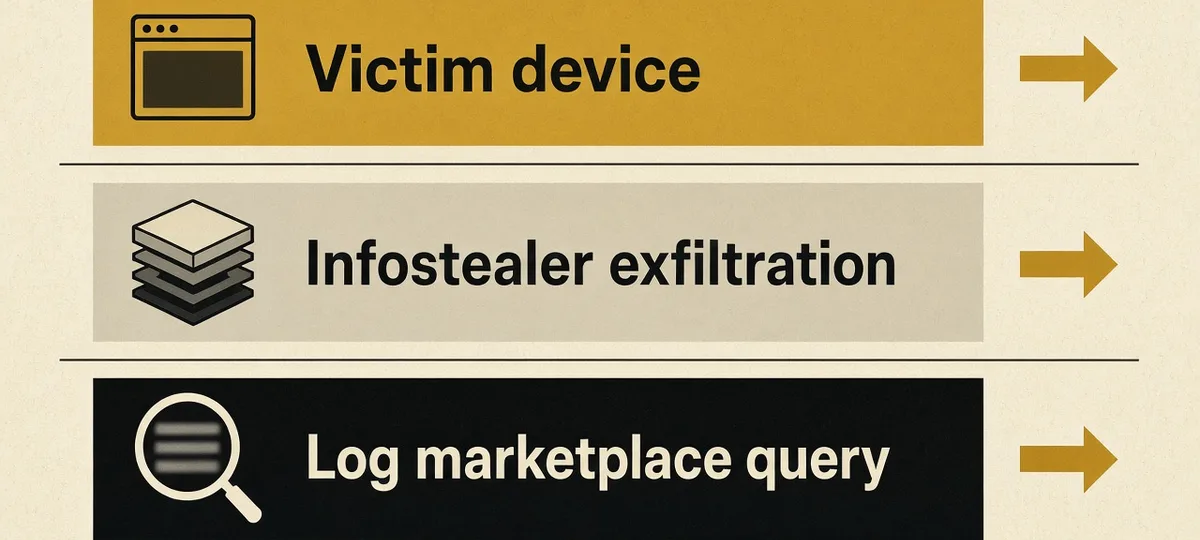
Once data leaves the host, operators monetize it in layers described in open research on centralized log marketplaces: sellers upload or pipe logs into a platform that lets buyers query by URL, country, or malware tag; initial-access brokers test valuable corporate cookies; remaining lines are resold cheaply in bulk. Sekoia’s overview of the Russian-speaking infostealer ecosystem describes dedicated marketplaces where qualified logs are advertised in a wide per-log price band depending on freshness and account value—not as a shopping guide, but as evidence that pricing and search matter as much as raw volume.
Platform choice has shifted over time. The Cambridge stolen-data market survey reports movement away from slow forums toward shops and messaging apps that can relist stock quickly after a takedown elsewhere. That agility is why a single shop seizure rarely dries up supply: the malware keeps infecting new hosts, and sellers route logs to the next venue or channel.
On 28 October 2024, authorities in the Netherlands, the United States, Belgium, Portugal, the United Kingdom, and Australia—with Eurojust coordination—took down infrastructure behind the RedLine and META infostealers. Eurojust’s release states that the malware stole usernames, passwords, cookies, wallet data, and autofill from infected devices and that operators sold the harvest through criminal marketplaces. Dutch police, in a parallel notice on Operation Magnus, reported that Telegram channels used to distribute those stealers were disrupted and that customer records from the seized infrastructure were under investigation. Cutting the malware supplier and seizing buyer lists are two different levers—both upstream of any single log shop name.
Carding shops versus stealer-log platforms
Carding shops rose from magstripe and track-data dumps toward e-commerce fraud. U.S. enforcement against BidenCash illustrates scale on the financial side: the Eastern District of Virginia announced on 4 June 2025 that the shop, operating since March 2022, had more than 117,000 customers, sold more than 15 million card numbers, and earned more than $17 million, including promotional giveaways of millions of cards. That case is card data at warehouse volume—not session cookies from a CFO’s laptop.
Stealer-log platforms sell per-device archives. Threat-intelligence firm KELA’s December 2021 analysis of the 2easy marketplace—cited in industry reporting, not revisited here as a live service—described searchable URLs, seller ratings, and zip files containing credentials, cards saved in browsers, and process lists tied to a single infected machine, with RedLine dominant among listed bots at the time. Independent researchers have tied the same ecosystem to later account-takeover incidents when a purchased cookie bypassed a victim’s controls. The lesson for defenders is inventory shape: card shops reward BIN and geography filters; log shops reward domain and identity-provider searches.
English-language headlines sometimes conflate the two because both appear on “dark web market” lists. Operationally they feed different fraud teams—card testers versus BEC and ransomware initial-access crews—and fall under different monitoring playbooks.
What takedowns and leaks change for defenders
Enforcement against stolen-data venues produces more than a seized banner. It yields warrants, sanctions designations, arrests of buyers, and databases that feed the next wave of cases.
| Action | Date | What agencies documented | Primary record |
|---|---|---|---|
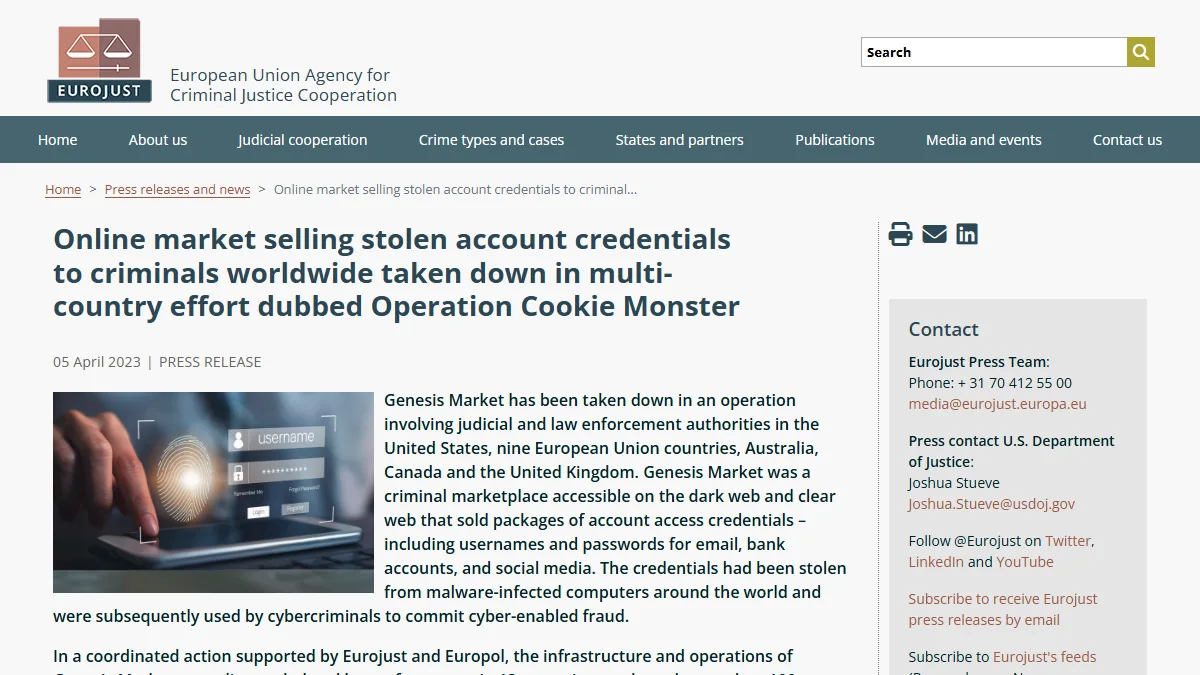
| Operation Cookie Monster (Genesis Market) | 4–5 April 2023 | Market selling malware-derived “bots” and credentials; infrastructure seized; large-scale arrests and searches of customers | Eurojust; Treasury sanctions; DOJ CCIPS fact sheet |
| Operation Endgame | 27–29 May 2024 | Disruption of dropper malware ecosystems used to deliver ransomware and other payloads—not a log shop, but strikes initial-access plumbing | Europol |
| Operation Magnus (RedLine / META) | 28 October 2024 | Infostealer infrastructure and sales channels disrupted; customer data seized for follow-on investigations | Eurojust; Dutch National Police |
| BidenCash seizure | 4 June 2025 | Large-scale stolen-card marketplace domains and crypto seized | EDVA |
Genesis Market is the reference case for how session resale worked at scale before April 2023. Dutch and Europol press material from Operation Cookie Monster estimated roughly 1.5 million listed bot packages and more than two million infected victims, with arrests and hundreds of searches targeting purchasers—not only administrators. The U.S. Treasury’s designation described packages indexed by device and listed approximately 460,000 for sale as of February 2023, each representing one compromised machine. After such a takedown, researchers documented newcomers absorbing demand; that redistribution is why defense focuses on exposed credentials rather than on which shop is largest this month.
Breach aggregation services sit on the legal side of the same information asymmetry. Have I Been Pwned, described in its public FAQ, ingests breach files and lets people check whether an email appeared in known incidents, with domain-wide monitoring for verified organizations. It is not a dark-web crawler; it complements—not replaces—enterprise stealer-log monitoring and law-enforcement bulletins. When a government advisory or private intel firm publishes indicators from a seized marketplace, security teams fold those into password resets, device reimaging, and fraud rules. More on how agencies publish coordinated actions is on darknet enforcement and darknet news.
Operation Endgame belongs in the same mental model with a different label: Europol’s May 2024 announcement targeted droppers such as IcedID, SystemBC, and Pikabot that pave the way for ransomware deployment, reporting more than 100 servers disrupted and thousands of domains taken under law-enforcement control. Disabling droppers does not delete logs already stolen, but it breaks a common path from phishing email to enterprise encryption—upstream of the shops that sell the resulting access.
What security teams monitor without visiting shops
CISA and the FBI’s guidance on infostealers emphasizes prevention and detection on corporate endpoints: resisting phishing, application allowlisting, separating privileged accounts, and watching for anomalous PowerShell or credential-access behaviour. Those controls shrink the pool of hosts that ever become “bots” for sale.
Where infection already happened, mature programs combine internal telemetry with external intelligence: stealer-log feeds that alert when an employee email or corporate subdomain appears in a fresh archive; compromised-credential checks against HIBP or commercial equivalents; and fraud-team review when session cookies for SaaS identity providers show up alongside passwords. Prioritisation typically ranks enterprise identity providers, VPN and remote access, and cloud admin consoles above trivial web sign-ups—because a single SSO cookie can outrank dozens of abandoned forum passwords.
After Genesis-scale takedowns, law-enforcement partners have encouraged victims to report misuse and to assume purchased data may still circulate in copies. The practical defender task is unchanged: treat stealer-log appearance as a probable session compromise, not merely a password rotation ticket.
If your credentials or cards show up
Individuals who receive a breach notice, a bank fraud alert, or an employer warning about stealer logs should act in an order that matches the threat: assume active sessions may be valid even after a password change.
- Change passwords on every account that reused the exposed password, starting with email and financial logins.
- Revoke sessions where the service offers “sign out everywhere” or device management—critical when cookies were stolen, not just passwords.
- Enable phishing-resistant MFA (hardware security keys or passkeys where supported) on high-value accounts; SMS alone may not help if SMS-based recovery was also captured.
- Watch financial and identity channels for new accounts opened in your name if card or tax data appeared in a carding dump.
- Report through your employer’s security team or national cybercrime reporting if you were targeted at work—agencies cannot link your case to seized shop data without reports.
None of these steps requires visiting a criminal marketplace, and none guarantees that a copied log vanishes from every reseller; they reduce the window in which a buyer can monetize the data.
Questions readers ask about stolen data shops
What do stolen data shops sell besides credit card numbers?
Log archives from infostealers, username-password pairs, session cookies, device fingerprints, remote access to compromised hosts, and sometimes whole files exfiltrated with the malware. Carding-focused shops emphasize payment-track data; log platforms emphasize searchable web credentials tied to an infected machine.
What is an infostealer log?
A packaged export from one infected computer: browser-saved passwords, cookies, autofill, wallet files, and system metadata, often tagged with the malware family that collected it. Buyers search those inventories for logins to specific URLs or domains rather than buying anonymous bulk text.
What happened to Genesis Market?
International authorities dismantled it in Operation Cookie Monster, announced 4–5 April 2023. Eurojust and partner agencies seized infrastructure, arrested buyers in multiple countries, and documented millions of compromised identities offered as “bots.” OFAC simultaneously sanctioned the marketplace.
How is Operation Endgame different from a log-market seizure?
Operation Endgame, in May 2024, targeted dropper malware that delivers ransomware and other payloads into networks. Log-market takedowns attack resale venues for data already stolen from endpoints. Both disrupt cybercrime, but at different stages of the chain.
What should you do if your work email appears in a stealer log?
Notify your security team immediately, assume cookies may still authenticate, reset passwords without reuse, revoke active sessions, and adopt stronger MFA on corporate identity providers. Personal email can be checked against legitimate breach services such as Have I Been Pwned while waiting for employer-led triage.
Are carding shops and stealer-log markets the same?
They share criminal customers and cryptocurrency payments, but merchandise and search interfaces differ. Card shops optimize card-not-present fraud; log shops optimize account takeover and network access from browser data.
How does Have I Been Pwned relate to dark-web shops?
It indexes many breaches and leaks submitted to the project or aggregated from public disclosures; it does not mirror live shop inventories. A “clear” HIBP result does not rule out a fresh stealer log that has not yet appeared in any breach file.
How we know what we say about stolen data shops
Arrest counts, seizure dates, and marketplace scale for Genesis Market, BidenCash, Operation Endgame, and Operation Magnus come from the Eurojust, Europol, U.S. Justice Department, Treasury, and Dutch police pages linked in the table above. Behaviour of infostealers and defender mitigations follow the FBI–CISA LummaC2 advisory and Eurojust’s description of RedLine and META. Research on log marketplaces and malware-to-sale pipelines cites the Cambridge stolen-data market survey and Sekoia’s public write-up on centralized log trade—labeled as research, not as observations of live shops. We have not accessed criminal marketplaces or tested stolen data. How we separate agency fact from assessment is in our editorial standards.