Why newsrooms run onion services: reader mirrors, SecureDrop, and what differs from markets
Updated
A search for securedrop onion mostly surfaces address directories and submission guides, which is useful if you already intend to leak documents. It does less to answer the wider question: why serious news organisations put anything on Tor at all, and how that legitimate layer relates to the drug markets and extortion blogs people usually picture. Newsrooms use onion services in two different ways. Some publish a Tor-only mirror of their public site so blocked readers can follow the news. Others run SecureDrop, an onion-based tip line so sources can send files without email providers sitting in the middle. Both stay inside the Tor network end to end, which is the technical reason they differ from ordinary Tor browsing and from criminal storefronts. This page explains that split, ties each part to primary announcements and documentation, and points to useful onion links for verified addresses and character-by-character checking. It does not repeat the address table there.
Reader mirrors and SecureDrop solve different problems
When the BBC announced its international news mirror in October 2019, it framed the move as access for audiences in countries that block or restrict BBC News, naming China, Iran, and Vietnam, and quoted University College London security researcher Steven Murdoch on onion services taking load off scarce exit nodes, preserving end-to-end encryption, and resisting spoofing through self-authenticating names. The BBC News technology story is a reader-mirror case: the goal is to deliver the same reporting the World Service already publishes, not to open a new channel for secrets.
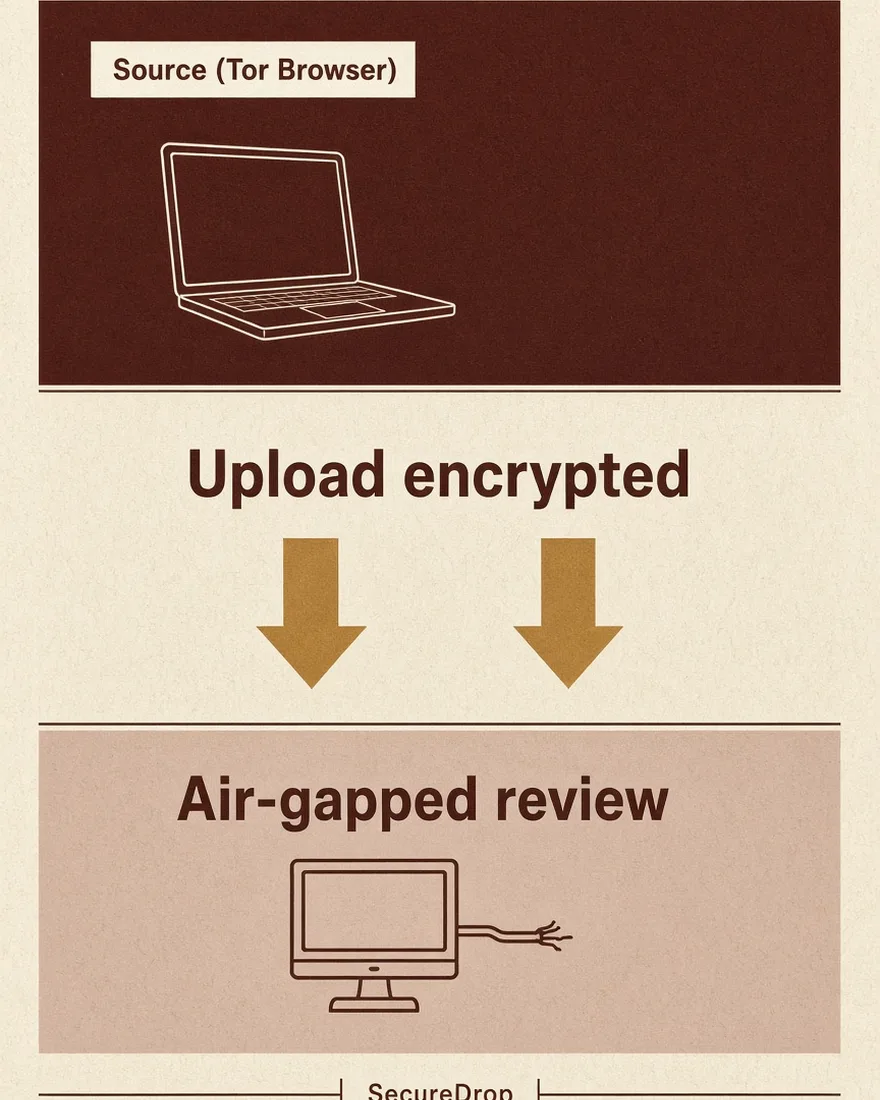
SecureDrop is the other model. The SecureDrop documentation describes it as an open-source whistleblower submission system news organisations install on dedicated servers on their premises. Sources connect with Tor Browser to a public onion interface and upload encrypted material; journalists use a separate authenticated onion interface from a hardened workstation, then move ciphertext to an air-gapped viewing station for decryption. The project began as Aaron Swartz’s DeadDrop in 2012; The New Yorker’s StrongBox launched in May 2013; Freedom of the Press Foundation took over development in October 2013 and renamed it SecureDrop. The same documentation stresses that the application tries to eliminate third parties from journalist–source metadata trails, because leak prosecutions in the United States have often rested on data held by email and phone providers.
One newsroom may run both: a public mirror for readers and a SecureDrop instance for sources. They are not interchangeable. Visiting a reader mirror leaves the same traces any news site would if you identify yourself; SecureDrop is built so the newsroom’s own servers, not Google or AT&T, sit between source and reporter. The official SecureDrop directory lists active instances; each outlet also publishes its own tips or SecureDrop landing page on the clearnet. If two sources disagree, documentation and directory pages tell you to stop.
Why staying off exit nodes matters
Tor’s usual privacy path for the open web sends your traffic through three relays and then out an exit node to reach a normal HTTPS site. The exit sees which site you requested unless additional encryption protects the payload; your ISP still knows you are using Tor. That path can circumvent blocking, but it leaves a place a censor or observer can watch, and it loads the volunteer exit fleet.
An onion service—what people mean by a site with a Tor-only address—is hosted inside Tor. The Tor Project explains that these addresses use the special domain suffix, that nothing outside Tor can resolve them, and that the connection stays within the overlay from browser to server. Its overview lists three properties: cryptographic proof you reached the holder of the address’s private key, hidden server location, and encryption without an exit relay in the middle.
BBC engineering writing archived on the BBC Internet blog described the contrast plainly: readers could already open the ordinary BBC site through Tor and exit somewhere else, but that last hop is unencrypted at the gateway and vulnerable to interference. An onion service routes to a dedicated Tor endpoint for the publisher, removing exit-node risk and often improving performance for video. The Guardian’s May 2022 announcement of its own onion service made the same point for readers: the full path between reader and newsroom stays inside Tor, avoiding the hop between the Tor network and the open web where a malicious exit might sit.
SecureDrop inherits that architecture by design. Sources must use Tor Browser; the source interface is itself an onion service. Journalists reach a separate authenticated onion service from a Tails-based workstation. The “what makes SecureDrop unique” page emphasises encryption in transit and on the server, minimal logging, and decryption only on an air-gapped machine so a network intrusion does not immediately expose readable documents. None of that is true of a drug market’s web forum, but it is central to why FPF recommends Tor for every submission.
Censorship resistance and the World Service mission
State blocking is the most cited public reason for reader mirrors. The Tor Project’s 2017 post encouraging newsrooms and NGOs to “onionize” opens with countries silencing critical sites and argues that publishing on onion services circumvents many blocking techniques while giving visitors stronger authentication than a lookalike domain on the open web. It explicitly compares onion addresses to HTTPS: same organisation, stronger properties for the visitor.
Outlet announcements echo that frame. ProPublica’s 2016 technical write-up, updated in 2021, described giving readers a more secure and anonymous way to access investigative reporting, motivated in part by experiments around Chinese censorship during its “Inside the Firewall” project. ProPublica’s podcast on joining the “dark web” stressed reader choice over ad tracking as well as restrictive countries. Freedom of the Press Foundation’s “Onions on the side” article tracked how few major news sites advertised onion mirrors via the Onion-Location header in Tor Browser 9.5, while noting that onion services reduce exit-node load and help readers bypass some network censorship.
After Russia restricted access to BBC content, the BBC’s March 2022 Media Centre advice listed circumvention tools including Tor Browser and pointed readers to its dedicated Tor site. That document is operational guidance for blocked audiences, not a general explainer, but it shows how mirrors sit beside VPNs and Psiphon in real crises. The addresses themselves belong on our useful onion links page, taken only from each publisher’s announcement.
What SecureDrop adds beyond “use Tor”
SecureDrop is not a pamphlet telling sources to mail USB sticks. It is a full workflow: separate source and journalist interfaces, GnuPG encryption, OSSEC and other hardening on the application servers, Tails for journalist workstations, and mandatory air-gapped review. The source how-to guide walks a first-time user through generating a random codename, uploading a single document or archive up to the documented size limit, and returning later with that codename to read replies—without SecureDrop storing IP address, browser fingerprint, or a traditional account.
Freedom of the Press Foundation maintains the directory of instances that meet its security standards and has introduced shorter mnemonic onion names for participating outlets, documented in the admin guide on onion names. Those names map to full v3 addresses through a signed ruleset in desktop Tor Browser; they are optional conveniences, and documentation still recommends publishing both forms on the landing page. None of that replaces verification against the newsroom’s own site.
FPF’s “five things to know” post stresses that the software is free but hardware and training are not, and that no system is perfect despite regular audits. That honesty matters for readers comparing SecureDrop to email: email is familiar but drags in providers who may comply with secret orders; SecureDrop pushes legal process toward the news organisation that owns the server.
Who runs reader onions and who runs SecureDrop
Adoption is uneven. Reader mirrors are still a minority among global publishers. Freedom of the Press counted only four large news organisations advertising main-site onions via Onion-Location headers in its 2021 survey, naming The New York Times, ProPublica, Deutsche Welle, and taz.de at that time. The New York Times described its 2017 onion experiment on the Open blog as a way to reach blocked or privacy-conscious readers; a March 2025 update on the same post said the Times was shutting that Tor site and applying lessons to its main products instead—illustrating that reader mirrors are optional experiments, not universal infrastructure.
SecureDrop adoption is broader among investigative outlets. The directory lists dozens of instances across countries, from major U.S. and U.K. papers to smaller nonprofits. Facebook was the first large company to host an onion service in 2014, according to widespread reporting cited on our useful-links page; that was user access to a social network, not journalism, but it showed Fortune-scale organisations accepting Tor’s model. Proton and other mail providers later published onions for similar blocking reasons.
None of these services publish addresses in Darkhelp articles. The rule, spelled out on useful onion links, is unchanged: copy the address from the owner’s site or the FPF directory, compare every character, and reject lists anyone can edit.
How legitimate news onions differ from markets and leak sites
All of the above shares Tor with criminal sites, which is why search results conflate “onion” with contraband. The structure of the service separates them.
Darknet markets are multi-vendor bazaars with escrow, reputation scores, and operators who profit from commissions. They need persistent payment rails and public catalogues. Newsroom reader mirrors deliver articles anyone could read on the clearnet; they do not sell goods or hold cryptocurrency in escrow. SecureDrop intake is one-to-one between source and journalists, with encryption and air gaps instead of star ratings.
Ransomware leak sites are another onion use case: public naming of victims to extort payment, documented in U.S. cybersecurity advisories as part of double extortion. They publish stolen material as leverage. SecureDrop does the opposite—conceal sources and hold submissions until journalists choose to publish after verification. A reader mirror is also public-facing journalism, not a countdown to data dumps.
Police interest differs accordingly. Market takedowns and leak-site disruptions, described on darknet news and enforcement pages, target criminal infrastructure. SecureDrop is installed by the newsroom itself; lawful access attempts go to the publisher, which is why the documentation talks about challenging orders. That legal posture is unlike a market admin hiding offshore.
| Use case | Who it serves | Typical goal | Darkhelp coverage |
|---|---|---|---|
| News reader mirror | Blocked or privacy-conscious audiences | Publish the same reporting without exit-node exposure | Useful onion links |
| SecureDrop tip line | Anonymous sources and journalists | Receive documents with minimal metadata | This page; FPF directory |
| Darknet market | Buyers and vendors of illegal goods | Escrowed commerce and reputation | Darknet markets |
| Ransomware leak site | Extortion crews and their targets | Public pressure to pay ransoms | Ransomware leak sites |
Tor itself is neutral infrastructure. The Tor Project’s nonprofit status and U.S. government historical funding appear in every BBC Tor explainer, but the network does not choose what is hosted. Legitimate publishers adopted onion services early for censorship and source protection; criminal adopters followed for different incentives. Confusing the two is a category error, not a technical one.
How we know what we say about onion newsrooms
Technical descriptions of onion services come from the Tor Project’s support pages and community overview. SecureDrop architecture, history, and submission steps come from FPF’s published documentation and the instance directory. Outlet motives and launch dates come from linked BBC, Guardian, ProPublica, Freedom of the Press, and New York Times Open announcements, not from Darkhelp testing those services. We have not connected to any newsroom onion or SecureDrop instance while researching this page. How we label certainty and link primary records is set out in our editorial standards.
Questions people ask about newsrooms and onion services
What is SecureDrop and why is it only on Tor?
SecureDrop is FPF’s open-source whistleblower system for news organisations. Sources must use Tor Browser because the submission interface is an onion service, which hides network metadata and keeps traffic off exit relays, as described in the official documentation.
Why did major news sites launch onion versions of their websites?
Outlets including the BBC and The Guardian cited censorship, blocking, and reader privacy. Onion mirrors let audiences read the same journalism inside Tor, with encryption end to end and no exit-node hop, as their announcements and the Tor Project’s advocacy posts explain.
What is the difference between opening a news site in Tor Browser and using its onion address?
Opening the ordinary domain still uses an exit relay to reach clearnet hosting. An onion address connects to a service inside Tor only, which removes the exit from that path and can resist IP-based blocking, as the Tor Project and BBC engineering posts describe.
How is SecureDrop different from emailing a newsroom?
Email routes through providers who may hold metadata and content under legal orders. SecureDrop keeps communication on the newsroom’s own servers, encrypts submissions, and limits logging, according to FPF’s “what is SecureDrop” and “what makes SecureDrop unique” pages.
Are onion services only for crime?
No. Tor documentation and publisher announcements describe legitimate uses including news distribution, secure tips, and blocked-reader access. Criminal markets and leak sites are separate use cases on the same network, covered elsewhere on Darkhelp.
Who maintains SecureDrop and the official directory?
Freedom of the Press Foundation develops SecureDrop and publishes the directory of participating instances. The software is AGPL-licensed; each newsroom hosts its own hardware.
How do newsroom onion services differ from darknet markets?
Markets run escrowed commerce with vendor reputations; newsroom reader mirrors publish journalism, and SecureDrop handles confidential tips without public listings. Neither news model matches market economics or law-enforcement targeting patterns for drug bazaars.